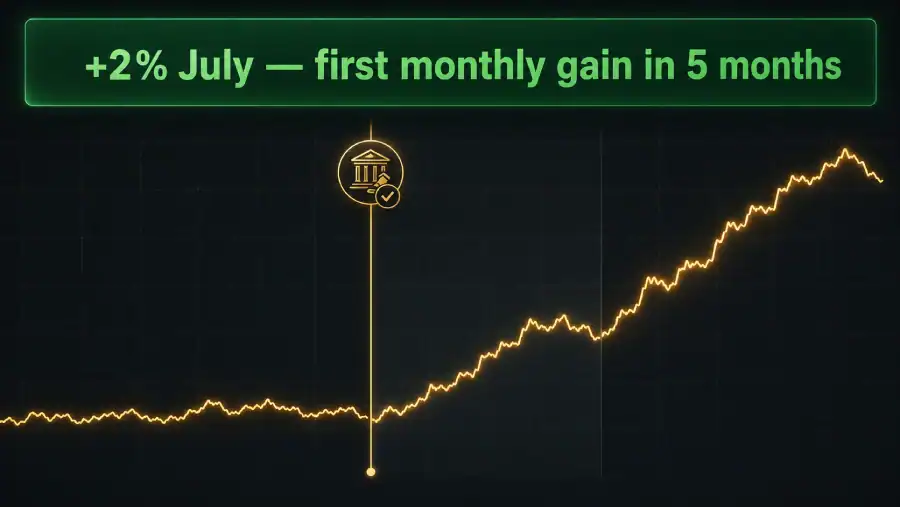
Gold Eases Toward $4,060 but Heads for Its First Monthly Gain in Five Months
Gold is easing back about 1.2% this Friday July 31, trading around $4,056 to $4,086 per ounce after a strong two-day rally that followed the Federal Reserve’s decision. Despite today’s pullback, the metal is on track to finish July with its first monthly gain in five months — a meaningful milestone after a long, difficult stretch. The week has been shaped by a Federal Reserve decision, cooling inflation data, a weaker dollar, and a reignited war, all pulling gold in different directions. Here is what buyers need to know.
Start with Wednesday’s main event. The Federal Reserve held interest rates steady at 3.50% to 3.75%, as widely expected — but three committee members dissented, favouring a 25-basis-point hike, and Chair Kevin Warsh struck a firm, hawkish tone. He reaffirmed the Fed’s commitment to bringing inflation down to its 2% target and said the central bank has “no higher soft target” for inflation. Gold’s initial reaction was a 2% rally, as the dollar and Treasury yields fell on the rate hold. But as markets digested Warsh’s hawkish message, some of that enthusiasm faded.
Thursday brought encouraging inflation news, which helped gold. The Fed’s preferred inflation gauge, the core PCE Price Index, rose just 0.1% in June — below the 0.2% forecast — and annual core inflation eased to 3.3% from 3.4%. Headline PCE actually fell 0.1%, the first monthly decline since April 2020, helped by lower gas prices during the brief war truce. At the same time, second-quarter economic growth came in at just 1.5%, below the 2.1% forecast, signalling a moderating economy. Cooler inflation and slower growth reduce the pressure for aggressive Fed hikes, which supports gold.
A weaker US dollar has been another key support. The dollar index slid toward 99.9 to 100.9 — its lowest since mid-June — partly on suspected intervention by Japanese authorities to support their weakening yen. A softer dollar makes gold cheaper for international buyers and typically lifts the price.
Working against gold are two forces. First, Warsh’s hawkish tone and the three dissenting votes keep the prospect of a September rate hike alive — markets price roughly a 60% to 63% chance, though that is down from about 81% before the Fed meeting. Second, the war reignited: the US launched fresh strikes on Iran in what Central Command called “a powerful response” to an attempted Iranian attack on US forces, and President Trump indicated the Iran deal is effectively off. Elevated oil and energy-driven inflation risk keep the Fed cautious.
For buyers, gold near $4,070 is about 27% below January’s record of $5,597 and up roughly 21.5% over the past year. Even after a hawkish Fed, Bank of America maintained that it sees $5,000 in reach once the tightening cycle ends, though it trimmed its 2026 average forecast to $4,360. The structural floor holds: central banks bought a net 41 tonnes in May and 244 tonnes in the first quarter, with 89% of reserve managers expecting global holdings to keep rising. Watch today’s Chicago PMI and University of Michigan inflation expectations, and next Friday’s July jobs report.
Today’s prices: 24K — $130.40/gram | 22K — $119.55/gram | 21K — $114.10/gram
All prices USD. Friday July 31 indicative. Volatile market. Confirm in store before purchase.