Gold’s Strongest Week Since January Meets Its Biggest Test: Jobs Day at Seven-Week Highs
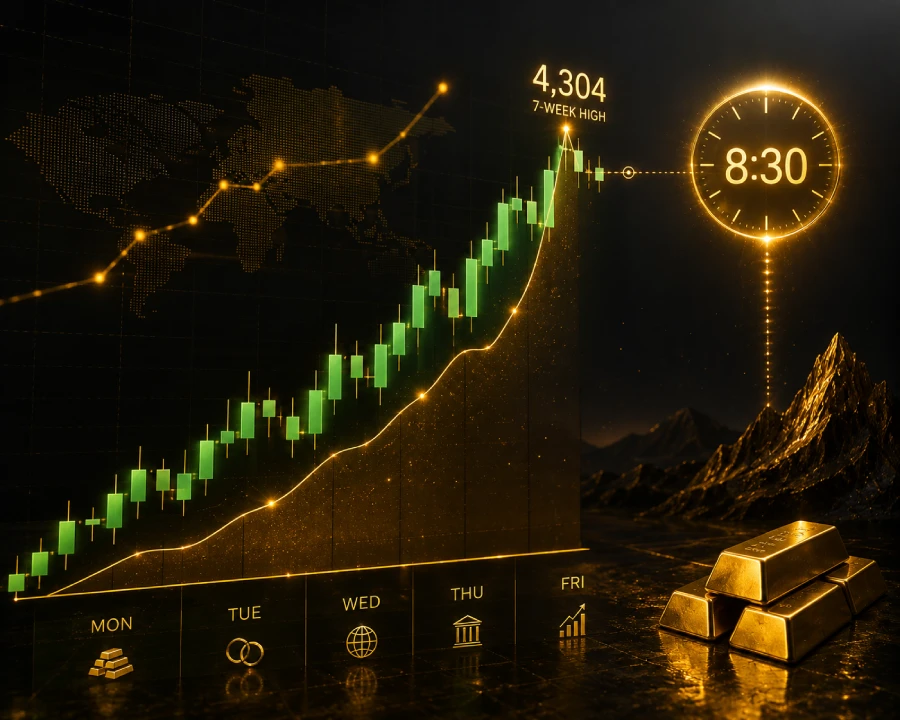
Gold enters this Friday August 7 near seven-week highs around $4,250 to $4,300 per ounce, capping its strongest week since January — a rally of roughly 6% that has added about $200 an ounce since Monday. The surge was ignited by the most concrete diplomatic breakthrough of the entire war: Iran’s announcement of an understanding with Oman on a shipping route through the Strait of Hormuz. But the week’s final and possibly decisive act arrives this morning at 8:30 AM ET, when the July US jobs report lands on a market already stretched by its own rally. Here is the full picture.
The breakthrough came Wednesday, and its effect was dramatic. Iran said it had reached an understanding with Oman on a proposed shipping route through the strait, with a joint statement containing the main points in the final stages of drafting. According to a senior Iranian source and two regional officials speaking to Reuters, the proposed deal would give Tehran control over vessels entering the Gulf through Hormuz. Markets read this as the beginning of the end of the energy chokehold that has fed global inflation all year: Brent crude fell below $80 a barrel, and gold rocketed more than 4% — its strongest daily advance since February — through $4,300 at Thursday’s peak of $4,304.
The rate consequences were immediate and profound. Expectations for a September Federal Reserve hike eased to about 55% from 67% two days earlier, and markets now price just one hike by year-end, compared with two as recently as last week. Lower oil means lower inflation means less pressure on the Fed — the chain this market has traced all year, finally running decisively in gold’s favour. A weaker dollar amplified the move: the dollar index touched a two-month low of 99.66 after coordinated US-Japanese intervention to support the yen, with Japan reportedly selling nearly $60 billion of Treasuries to finance the operation.
But Friday opened with a complication that captures this war’s stubborn refusal to resolve cleanly. Iran’s semi-official Fars news agency reported that a parliamentary committee is reviewing a preliminary bill that would bar US, Israeli and other “hostile” vessels from transiting Hormuz, with fines up to 20% of a ship’s cargo value for violations. Oil rebounded firmly on the headlines — WTI near $75.85, Brent near $80.23 — reviving doubts about how complete any reopening will be. Adding a hawkish note, the Financial Times reported Fed Chair Kevin Warsh stands prepared to raise rates if inflation stays elevated, nudging September odds back toward 60%. Gold pulled back from $4,304, then found fresh demand in Asia this morning.
All of which frames today’s jobs report as the week’s true verdict. ADP data already showed private hiring slowed in July, but jobless claims came in stronger than expected, muddying the picture. A soft payrolls number with benign wages would cement the dovish repricing and open the path toward $4,380, analysts say. A hot print would put the Fed’s September hike scenario back in sharp focus and risk a deeper pullback toward $4,200. With gold up 6% in a week, the market is positioned for good news — which raises the stakes if the number disappoints.
For buyers, gold near $4,270 is about 24% below January’s record of $5,597 and up roughly 25% over the past year. The structural story strengthened this week: Chinese institutional investors keep adding gold positions, and while the World Gold Council reported global Q2 demand at 942 tonnes — the lowest since 2021, as investment demand halved — central banks kept buying throughout. Today at 8:30 AM ET, the week’s remarkable rally faces its examination.
Today’s prices: 24K — $137.30/gram | 22K — $125.85/gram | 21K — $120.15/gram
All prices USD. Friday August 7 indicative. Jobs report today — highly volatile. Confirm in store before purchase.